
YouTube Monetization Requirements in 2026 (and the 2027 Change)
Every YouTube monetization requirement in 2026: subscribers, watch hours, Shorts views, policy checks — and the doubled thresholds coming February 2027.
Three creators can each cross 1,000 subscribers this month and get three different outcomes. One gets accepted into the YouTube Partner Program in about a month. One gets rejected on watch hours despite having more subscribers than the other two combined. One gets accepted, monetized — then has ad revenue pulled from specific videos six weeks later for reasons that have nothing to do with subscriber count.
That gap is what most rundowns of youtube monetization requirements leave out: the subscriber and watch-hour numbers are necessary, but they’re not the whole gate. YouTube reviews the channel, not the spreadsheet. Here’s every current threshold — both YPP tiers, the policy requirements that catch channels the numbers alone wouldn’t, and the February 2027 change that doubles what a new channel needs to walk through the door.
Key Takeaways
- Two tiers exist, not one: 500 subscribers unlocks fan funding (memberships, Super Chat, Super Thanks); 1,000 subscribers plus 4,000 watch hours (or 10M Shorts views in 90 days) unlocks ad and Premium revenue.
- The subscriber math is necessary, not sufficient — YouTube’s July 16, 2026 policy clarification names three specific content categories that stay unmonetized no matter how many subscribers a channel has.
- Realistic AI-generated or AI-altered content needs the disclosure toggle on, or it risks a label, removal, or Partner Program suspension — even when it would otherwise qualify on the numbers.
- From February 1, 2027, new applicants need 8,000 qualified watch hours or 20 million Shorts views to enter YPP — double today’s bar. Creators already inside YPP are grandfathered in.
- The 500-subscriber fan-funding tier isn’t changing in 2027 — only the full ads-and-Premium tier’s entry requirement is doubling.
YouTube Partner Program thresholds, at a glance
500
Subscribers to unlock fan funding
1,000
Subscribers to unlock ad + Premium revenue
4,000 → 8,000
Watch hours: today vs. new applicants after Feb 2027
10M → 20M
Shorts views (90 days): today vs. after Feb 2027
Sources: YouTube Partner Program overview & eligibility · YouTube Blog — Aug 10, 2026
YouTube monetization requirements today: two tiers, not one
Most creators only know the 1,000-subscriber, 4,000-hour number. It controls ad revenue and YouTube Premium revenue sharing — the two biggest income lines for most channels — but it isn’t the only door. Since 2023, a lower tier at 500 subscribers has unlocked viewer-funded features on its own, separate application, separate math.
| Fan funding tier | Full monetization tier | |
|---|---|---|
| Subscribers | 500 | 1,000 |
| Public uploads | 3 in the last 90 days | No separate upload count |
| Watch hours | 3,000 in the last 12 months | 4,000 in the last 12 months |
| Or Shorts views | 3 million in the last 90 days | 10 million in the last 90 days |
| What it unlocks | Channel memberships, Super Chat, Super Stickers, Super Thanks, Shopping | All of the above, plus ad revenue and YouTube Premium revenue share |
Both tiers run on “or” logic — a channel needs the subscriber count plus either the watch-hour figure or the Shorts-view figure, not both. One technical catch trips up a lot of Shorts-heavy channels: watch hours generated by Shorts in the Shorts Feed don’t count toward the long-form 4,000-hour threshold. A channel posting only Shorts has to clear the Shorts-views path — 10 million views in 90 days — because the watch-hour path is effectively closed to it.
For a channel building from zero, the practical sequence is usually fan funding first, full monetization second — see starting a channel from zero subscribers for what the first 500 actually take. And subscriber count on its own answers a different question than eligibility does — for what subscriber count actually turns into income, the eligibility gate is only step one.
The YouTube Partner Program requirements everyone still needs
Hitting the subscriber and watch-hour numbers doesn’t submit the application by itself. YouTube’s own eligibility page lists a second set of requirements that apply regardless of which tier a channel is going for:
- No active Community Guidelines strikes on the channel
- Channel is based in a country where YPP is available
- 2-Step Verification turned on for the Google Account
- An AdSense for YouTube account linked (or ready to create one)
- Advanced features access enabled on the channel
- Compliance with every YouTube channel monetization policy — not just the subscriber math
The 90-day upload requirement on the fan-funding tier — three valid public uploads — is the one that quietly disqualifies channels that post in bursts and go quiet. It resets on a rolling basis, so a channel that hits 500 subscribers and then goes dark for three months can fall back out of eligibility without losing a single subscriber. See how often you need to publish to stay active for what a sustainable cadence looks like.
The policy requirements beyond the numbers
This is the part most youtube monetization rules explainers skip, and it’s the part that actually rejects channels sitting well above the subscriber threshold. YouTube’s monetization policy starts from a single originality standard:
“If you borrow content from someone else, you need to change it significantly” — enough that a viewer can tell the difference isn’t cosmetic.
— YouTube's channel monetization policies
On July 16, 2026, YouTube published a clarification of that standard, splitting non-monetizable content into three named categories. The update didn’t change the rule — YouTube has said repeatedly it’s a clarification, not a new ban — but it made the pattern explicit enough to self-audit against.
Generic or template-based
Same script, subject swapped
Low-effort structure repeated across uploads with only the subject changed — AI voice, AI or CGI visuals, or a fill-in-the-blank script, giving the impression of mass production.
- Templated scripts with minor substitutions
- Slideshow narration with no original research
- Tutorials duplicating what's already on the platform
Off-putting or manipulative
The hook lies about the payoff
Content built to provoke a reaction the payoff doesn’t earn — distress or outrage used as the hook rather than an honest byproduct of the story being told.
- Animal-distress footage cut for a rescue payoff
- Thumbnails that misrepresent the video
- Shock clips assembled with no narrative
AI personas, sensitive topics
Synthetic experts giving real advice
An AI-generated persona presented as a credentialed professional, giving advice on health, money, or law that a viewer could reasonably act on.
- Synthetic "doctors" or "financial advisers"
- AI legal guidance with no real practitioner behind it
- Political "experts" with no disclosed identity
Separately from the inauthentic-content policy, YouTube requires a disclosure toggle — labeled “altered or synthetic content” — for realistic AI-generated or AI-altered video: deepfakes, footage of real places that never happened, or synthetic scenes of real people doing things they didn’t do. Minor edits (color grading, beauty filters), scriptwriting assistance, and non-realistic AI content are exempt. Disclosing doesn’t hurt a video’s reach or its monetization eligibility — refusing to, consistently, is what risks a label, content removal, or YPP suspension.
Will your channel pass review?
The numbers get a channel to the application. These six questions are closer to what a human reviewer is actually checking once it’s there.
Swap the footage — does the video still make sense?
Viewers lose your narration, research, or framing and the video falls apart without it.
Nothing distinguishes it from ten other channels covering the same clip.
Could another channel have uploaded this exact video, unchanged?
No — the angle, structure, or voice is specific to this channel.
It's the same stock photos and the same three facts as everyone else's video on the topic.
Is there a human judgment call anywhere in it?
A position was argued, sources were weighed, something was left out on purpose.
It's a template with the subject swapped and nothing else changed.
Would a stranger feel manipulated once they saw the payoff?
The thumbnail and title deliver what the video actually promised.
Distress or shock as the hook, and the 'resolution' is a cheap coda tacked on after.
Does an AI-voiced or AI-rendered persona give advice on health, money, or law?
No persona, or a disclosed one adding context — not posing as a licensed professional.
A synthetic 'doctor' or 'advisor' delivering advice that sounds real enough to act on.
If it's AI-generated and looks real, is the disclosure toggle on?
Toggle is on, or the content is clearly not photorealistic.
Photorealistic AI content — a fabricated event, a real person doing something they didn't — with no disclosure.
YouTube monetization requirements 2027: what’s actually changing
On August 10, 2026, YouTube announced the first change to Partner Program entry requirements since 2018. Starting February 1, 2027, new applicants need 8,000 qualified watch hours in the last 365 days, or 20 million qualified Shorts views in the last 90 days — double the current 4,000 hours and 10 million views. YouTube’s own post is explicit that this “won’t impact creators already in YPP,” and that the fan-funding and shopping tier’s 500-subscriber thresholds are unchanged.
The new-applicant cliff: February 1, 2027
Anyone not yet accepted into YPP by that date needs the doubled numbers — 8,000 hours or 20M Shorts views — to apply. Anyone already approved keeps their existing status under the old math. There is no published mechanism to lock in the current thresholds early; the only lever is watch hours accumulated before the date the application is actually approved, not submitted.Doubling the bar to 8,000 hours changes the math for anyone starting from zero: it takes roughly twice the long-form output — consistent narrated video, not sporadic uploads — to clear it, which is the exact gap a research-to-render pipeline like Longform Studio’s exists to close. Watch-hour accumulation also isn’t format-neutral in the first place; see how watch-hour accumulation differs between long-form and Shorts for why the two paths reward completely different upload strategies.
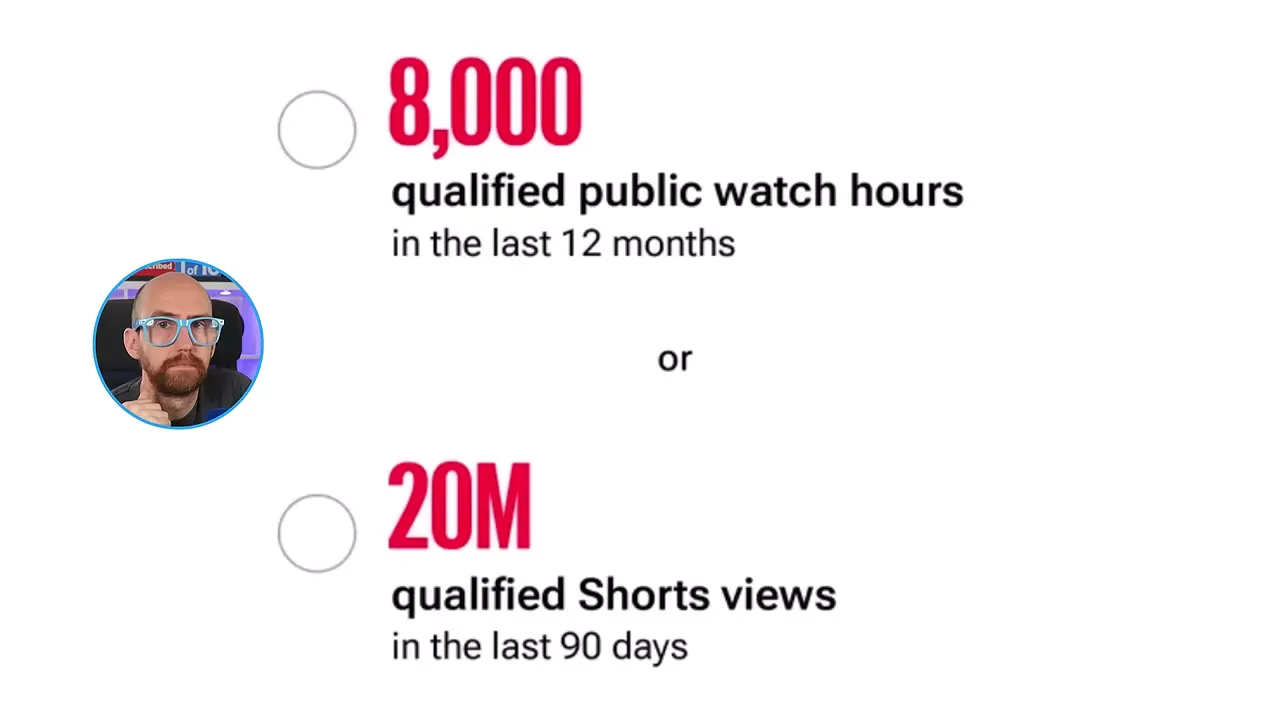
vidIQ (2.4M subscribers) posted a reaction video within an hour of the announcement going live, reading the blog post on camera and flagging the part creators tend to gloss over: this is the first time YouTube has raised the bar rather than lowered it.
“The last time YouTube made monetization requirements, they lowered them.” This time, by YouTube’s own account, they’re doubling them.
— vidIQ, reacting to YouTube's Aug 10, 2026 announcement
The same video is a useful reminder that eligibility isn’t a one-time checkpoint even under today’s numbers — the host mentioned losing Partner Program status years earlier for staying consistently under the watch-hour bar after approval, not for a policy strike. The threshold is a floor to maintain, not a gate that closes once and stays open.
One more wrinkle worth knowing: a separate, ongoing rule also takes effect February 1, 2027, and it applies to everyone earning from Shorts, new and existing alike. To keep ad and Premium revenue specifically on Shorts, a channel needs to stay above 10 million qualified Shorts views in a rolling 90-day window. Fall below it and Shorts revenue pauses — long-form earnings continue — and resumes automatically once the channel crosses back over. It’s a different mechanism from the one-time entry bar, and it’s easy to conflate the two. Once a channel does clear either threshold, what it actually gets paid per view is its own question — see what an approved channel actually gets paid per view and how many views translate into a real paycheck.
FAQ
How many subscribers do you need to monetize on YouTube?
500 subscribers unlocks fan funding — channel memberships, Super Chat, Super Stickers, Super Thanks — alongside 3 public uploads in the last 90 days plus 3,000 watch hours or 3 million Shorts views. Ad revenue and YouTube Premium revenue sharing need 1,000 subscribers plus 4,000 watch hours in 12 months, or 10 million Shorts views in 90 days.
Do the 2027 changes affect creators who are already monetized?
No. YouTube has said the new 8,000-hour and 20-million-view entry thresholds, effective February 1, 2027, apply only to new applicants — creators already accepted into the Partner Program keep their status under the old math. A separate, ongoing rule does apply to everyone earning from Shorts specifically: staying above 10 million qualified Shorts views in a rolling 90-day window is required to keep ad and Premium revenue on Shorts, though long-form earnings continue regardless.
Can AI-generated videos get monetized on YouTube?
Yes, but not automatically. YouTube's July 2026 policy clarification blocks monetization for generic or template-based AI content that looks mass-produced, not AI use itself — a video built on original research, commentary, or a genuine perspective can use AI tools throughout and still qualify. Realistic AI content also needs the 'altered or synthetic content' disclosure toggle turned on.
What happens if a channel falls below the watch-hour threshold after approval?
Eligibility isn't a one-time check. YouTube has removed creators from the Partner Program for staying consistently under the watch-hour bar after approval, separate from any policy violation — the thresholds are a floor to maintain, not a gate that closes once and stays open.
Does the fan-funding tier pay the same as full monetization?
No. The 500-subscriber tier only unlocks viewer-funded features — channel memberships, Super Chat, Super Stickers, Super Thanks, and YouTube Shopping. Ad revenue and YouTube Premium revenue sharing, which is where most channel income actually comes from, require the 1,000-subscriber, 4,000-hour tier.
Watch hours are about to matter twice as much
Longform Studio is built for exactly the metric YouTube just doubled: narrated, source-backed long-form video that racks up watch hours instead of one-shot views. Research, script, storyboard, consistent AI stills, and ElevenLabs narration in one pipeline — for channels clearing 4,000 hours today, or 8,000 after February 2027.
Try Longform Studio$49/mo plus transparent per-dollar production costs. No shorts, no content-farm shortcuts.