
How Many Views Do You Need to Get Paid on YouTube?
How many views it really takes to get paid on YouTube: the RPM math per niche, worked examples, and why views alone don't decide the paycheck.
Key Takeaways
- The formula that actually answers this: views ÷ 1,000 × RPM = payout. A view count alone tells you nothing until you know the RPM standing next to it.
- The same 250,000 views pays $1,000 in a low-RPM niche and $4,250 in a high-RPM one — identical audience size, more than 4x the paycheck.
- Before any of this math applies, you need 1,000 subscribers and 4,000 long-form watch hours (or 10 million Shorts views in 90 days) to join the YouTube Partner Program — and that bar is doubling for new applicants from February 2027.
- YouTube Shorts pay $0.03–$0.10 per 1,000 views versus $1–$30 for long-form — the reason a channel can rack up millions of Shorts views and still clear less than the price of lunch.
A video with 250,000 views and a video with 250,000 views can pay $1,000 apart. Same platform, same view count, same length of time on screen — and one creator is buying groceries with the difference. The number that decides it never shows up in the view counter: it’s RPM, and almost nobody explains how to run the math before they publish.
So here’s the honest answer to how many views you need to get paid on YouTube: there is no fixed number. There’s a threshold that makes you eligible to be paid at all, and then there’s a per-1,000-views rate that decides what any given view is actually worth — and those are two completely different questions that most explainers blur into one.
How many views do you need to get paid on YouTube?
Zero views unlock nothing on their own. What unlocks payment is the YouTube Partner Program threshold: 1,000 subscribers plus 4,000 public watch hours in the trailing 12 months, or 1,000 subscribers plus 10 million public Shorts views in the trailing 90 days. Clear either bar and you can link AdSense; miss it and it doesn’t matter if a video has 50 million views — none of it converts to a dollar.
Eligibility and earnings are not the same gate
Watch hours and subscribers decide whether you can be paid at all. RPM decides how much. A channel can clear the Partner Program threshold on its worst-performing niche and still earn far less per view than a smaller channel in a better-paying one. Full breakdown of every eligibility rule — policy checks, country availability, the works — is in our YouTube monetization requirements guide.And the eligibility bar is about to move. YouTube announced on August 10, 2026 that new applicants from February 1, 2027 will need 8,000 watch hours or 20 million Shorts views in 90 days — double the current requirement. Creators already in the program are grandfathered in unchanged, but anyone starting a channel now is effectively building toward a higher bar than the one their favorite creators cleared.
The formula: views ÷ 1,000 × RPM
Once you’re eligible, every dollar you earn from ads traces back to one calculation. Take your views, divide by 1,000, multiply by your RPM (revenue per thousand views — what you actually receive after YouTube’s cut and any views that didn’t serve a paid ad). That’s the whole formula. RPM itself moves with niche, audience country, season, and ad demand — the mechanics of what pushes it up or down are covered in YouTube RPM explained. This article is about what happens once you plug views into it.
250,000 views on a documentary-style video
Now hold the views constant and swap only the niche. The same 250,000 views pays four different amounts depending on whose ads are running against it:
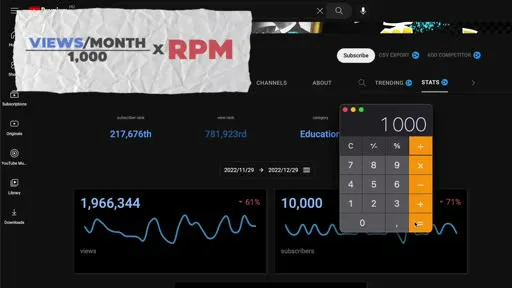
Creator Make Money Matt (961,000 subscribers) ran this exact calculation on three real channels using public view-count data, and the spread makes the point better than any hypothetical: a scary-stories channel, a finance channel, and a tech channel, at wildly different RPMs, and the highest-RPM channel out-earned the highest-view channel despite pulling in a fraction of the traffic. More on that in the worked examples below.
How much does YouTube pay per 1,000 views, by niche?
RPM ranges are wide and they overlap between sources — nobody outside YouTube sees the real average, so every figure below is a researched range, not a guarantee. Long-form RPM broadly runs $1 to $30 per 1,000 views across all niches, with most channels landing between $5 and $10, according to Make Money Matt’s research across his own channels and others he studied. Break that down by niche and the spread gets much wider:
| Niche | RPM range | 10,000 views | 100,000 views | 1,000,000 views |
|---|---|---|---|---|
| Finance / investing | $5 – $17 | $50 – $170 | $500 – $1,700 | $5,000 – $17,000 |
| Documentary / education | $9 – $14 | $90 – $140 | $900 – $1,400 | $9,000 – $14,000 |
| Gaming / general entertainment | $2 – $6 | $20 – $60 | $200 – $600 | $2,000 – $6,000 |
Finance RPM ranges come from vidIQ’s 2026 niche-profitability data, which puts finance CPM at $15–$50 and RPM at roughly a third to half of that. Documentary and education figures come from OutlierKit’s niche benchmark report, cross-checked against at least three independent data sources per their methodology. Gaming sits at the bottom of both lists — lower advertiser demand per view, even when the raw view counts dwarf everything else on the platform.
Same views, different math
A 100,000-view finance video and a 100,000-view gaming video are not the same event financially. One can pay nearly 3x the other. If you’re choosing a niche for income rather than passion alone, RPM range matters more than raw view potential — a niche with a lower ceiling on views but a higher RPM floor often wins on take-home pay.The trap: millions of views, $0 in long-form ad revenue
This is where the views-to-pay question breaks for most new creators. Shorts can generate views at a scale long-form never will — but Shorts revenue comes from a pooled fund split across everyone’s Shorts, not per-video ad impressions, and vidIQ’s Shorts monetization data puts the typical result at $0.03 to $0.10 per 1,000 views, with most creators clustered at the low end of that. Long-form, by contrast, runs $1 to $30 per 1,000 views on the same platform. That’s a 10x to 100x gap for the exact same unit of attention.
Long-form path
4,000 watch hours to unlock, $1–$30 per 1,000 views after
- Per-video ad impressions, not a pooled fund
- RPM set mainly by niche and audience
- A back catalog keeps earning via search for years
Best for: Anyone building toward income that compounds, not just view counts.
Shorts path
10M views/90 days to unlock, $0.03–$0.10 per 1,000 views after
- Revenue pooled and split by engaged-view share
- RPM swings hard video to video, same channel
- Feed-driven — most earning power fades once a Short stops circulating
Best for: Top-of-funnel reach and audience building, rarely a paycheck on its own.
We ran the full six-dimension comparison — watch time, audience relationship, algorithm shelf-life, sponsorship value, all of it — in long-form vs short-form content. The short version for this article: a channel can post Shorts that rack up tens of millions of views a month and still not clear the Partner Program’s long-form watch-hour bar, because Shorts views and long-form watch hours are counted — and paid — through entirely separate mechanisms.
Per-1,000-views extremes, long-form vs Shorts
$0.03–$0.10
Typical Shorts RPM per 1,000 views
$1–$30
Typical long-form RPM range, all niches
$17
High end of researched finance-niche RPM
4,000 hrs
Long-form watch hours required before any of this applies
Sources: vidIQ — YouTube Shorts Monetization 2026 · Make Money Matt — How Much YouTube Pays You For 1,000 Views
Three real channels, run through the math
Make Money Matt walked through this live using public view-count data from three channels in different niches, applying an estimated RPM to each based on what that niche typically commands. These are his on-camera estimates, not confirmed AdSense statements — but the method is exactly the one taught above, and the spread is the whole point.
| Channel | Subscribers | Niche | Monthly views | Est. RPM | Est. monthly ad revenue |
|---|---|---|---|---|---|
| Chills | 6.18M | Horror / scary stories | 6.5M | $3 | ~$20,000 |
| New Money | 1.09M | Investing / finance | 1.9M | $20 | ~$309,000 |
| TechZone | 4.75M | Technology | 46M | $10 | ~$460,000 |
Notice what actually drives the ranking: it isn’t subscriber count and it isn’t even views. New Money pulls fewer monthly views than either of the other two channels and still lands in the middle of the pack purely because finance RPM runs several times higher than horror content’s. Chills has the smallest revenue estimate of the three despite being the most-subscribed channel in the group. Faceless channels can absolutely produce numbers like these — we cover what’s realistic, niche by niche, in do faceless YouTube channels make money.
Find your actual RPM before you guess
None of the ranges above replace your own numbers. Inside YouTube Studio, under Analytics → Revenue, every monetized channel can see its actual RPM, not an estimate from a niche average. Watch it over a few months before drawing conclusions — Matt’s own research channel demonstrated the volatility well: an ad-revenue-only estimate of $6,000–$12,000 a month sitting next to a total monthly income near $100,000 once a paid product was added, a reminder that RPM math describes ad revenue specifically, not everything a channel earns.
Subscriber count is part of eligibility, not payout — a channel needs 1,000 subscribers to apply at all, but past that gate, subscribers stop moving the RPM number directly. We break down what subscribers actually contribute to income, separately from views, in how many subscribers you need to make money on YouTube.
If the RPM math above makes the case for long-form, the honest next question is production time — a 15-minute video is a bigger lift than a 45-second one. That gap is what Longform Studio is built to close: research, script, storyboard, consistent-character AI stills, ElevenLabs narration with measured timing, and a synced cloud render, for 8–30 minute videos, at $49/mo plus transparent per-dollar production costs.
FAQ
How many views do I need to get paid on YouTube?
There's no view-count trigger. You need 1,000 subscribers and either 4,000 public watch hours in the past 12 months or 10 million Shorts views in 90 days to join the YouTube Partner Program. Only after that does any view convert to a dollar — and even then, it's views multiplied by RPM that sets the amount, not the view count on its own.
How much does YouTube pay per 1,000 views?
Long-form video typically pays $1 to $30 per 1,000 views (RPM), depending on niche and audience location, with most channels landing between $5 and $10. YouTube Shorts pay far less — usually $0.03 to $0.10 per 1,000 views — because Shorts ad revenue comes from a pooled fund split by engaged-view share, not per-video impressions.
Can 10,000 views earn me anything?
Only once you've cleared the Partner Program threshold. At that point, 10,000 views in a $12 RPM niche pays roughly $120; the same 10,000 views in a $3 RPM niche pays about $30. The view count never tells you the number on its own — RPM does.
Why do I have millions of views and no ad revenue?
Two likely reasons: you haven't crossed the 1,000-subscriber and 4,000-watch-hour threshold yet, or the bulk of those views are Shorts, which are paid through a separate, much smaller revenue pool than long-form ads — millions of Shorts views can add up to single-digit dollars.
Is RPM the same thing as CPM?
No. CPM is what advertisers pay per 1,000 ad impressions before YouTube takes its share. RPM is what a creator actually receives per 1,000 views, after YouTube's cut and any views that didn't serve a paid ad. RPM is always the lower, real number to plan a channel's income around.
The views math favors long-form. Production time is the real blocker.
Longform Studio turns research into a scripted, narrated, storyboarded 8–30 minute video — the format with the RPM to match the work you're already putting in.
Try Longform Studio$49/mo plus transparent per-dollar production costs. No markup on provider usage.