
AI Documentary Generator: What It Takes to Automate a Doc
What an AI documentary generator has to solve — research, archival visuals, narration, length — and which tools get close in 2026.
Key Takeaways
- An AI documentary generator has to clear four bars a generic video tool never has to touch: sourced research, archival-vs-generated visuals, narration gravitas, and 20+ minute coherence.
- We traced a widely-watched “I made a documentary with AI” tutorial start to finish. It skips sourcing entirely — the script comes from a single ChatGPT prompt with zero citations — and tops out at 8 minutes.
- Stanford’s RegLab found general-purpose chatbots hallucinate on 58–88% of verifiable research questions — the exact failure mode a “write me a script about X” prompt walks straight into.
- Real events carry a rights and accuracy line generic tools never draw: AI-generated footage has no negative, no metadata, no chain of custody to check against.
An 8-minute “documentary” about the entire history of ancient Egypt, built from a single ChatGPT prompt template, ten-second clips generated in Google Flow across multiple free accounts to dodge the daily quota, and a text-to-speech voice picked off a preset list — with not one citation anywhere in the process. That’s what a widely-watched “I made a documentary with AI” tutorial actually produces today, and it’s a useful place to start, because it shows exactly where an AI documentary generator has to be a different kind of tool than the video generators built for a 30-second product demo or a meme clip.
A documentary isn’t just a longer video. It makes a factual claim about real people, places, or events, and it asks the viewer to trust that claim. That’s a different job than an explainer or a listicle, and it’s why making a documentary with AI breaks in specific, predictable places once you look past the one-prompt demo.
What an AI documentary generator has to solve
Four requirements separate a real documentary pipeline from a generic video tool with a longer runtime. None of them are optional, and a tool that skips one doesn’t produce a slightly weaker documentary — it produces something else wearing the format.
Sourced research
Claims a viewer can actually check
- Research grounded in named, checkable sources
- Claims traceable back to where they came from
- Disagreement between sources surfaced, not smoothed over
- Not a single 'write me a script about X' prompt
Best for: Any topic where a viewer could look up the claim and check it.
Archival vs. generated visuals
Recreation clearly separated from record
- Archival footage used and credited where it exists
- Generated visuals clearly recreations, not documents
- No AI 'footage' presented as period-accurate record
- Rights checked before reuse, not assumed
Best for: Real events, real people, real places — anything a viewer could mistake for the historical record.
Narration gravitas
A voice a viewer trusts for 20 minutes
- A voice and pace suited to serious subject matter
- Delivery timed to the actual sentence, not a guessed duration
- Tone that survives 20 minutes, not just a 30-second demo
- Not the same preset voice used for product reviews
Best for: Anything meant to hold a viewer's trust for more than a couple of minutes.
20+ minute runtime coherence
Coherent past the 8-minute demo length
- Hundreds of scenes held to one script, not stitched by hand
- Character and visual continuity across the full runtime
- Structure that survives a mid-episode edit
- Not a demo capped short because longer breaks the workflow
Best for: The actual format YouTube's documentary and history channels run in — 15 to 30+ minutes, not 8.
An honest test of the current tools
Rather than take a tool’s marketing page at its word, it’s worth watching what a real attempt looks like. AI Playbook (~19,300 subscribers) walks through the entire process, start to finish, in I Made a Full History Documentary with AI for FREE, and the workflow it demonstrates is the one most “how to make a documentary with AI” content on YouTube currently teaches.
The process: paste a “master template prompt” into ChatGPT, get ten topic ideas back, pick one — the video chooses “the entire history of ancient Egypt” — set a target length (8 minutes, “to keep the video clear and not too long”), and let ChatGPT write the full script in one pass. A second prompt turns each line of that script into a per-scene visual description. Those descriptions go into Google Flow one at a time, generating a 10-second clip per prompt — and because the free tier caps daily generations, the video recommends switching to a different account partway through to keep going. The finished script gets pasted, unedited, into a text-to-speech tool for narration, and CapCut stitches the voiceover and clips together with music and text overlays.
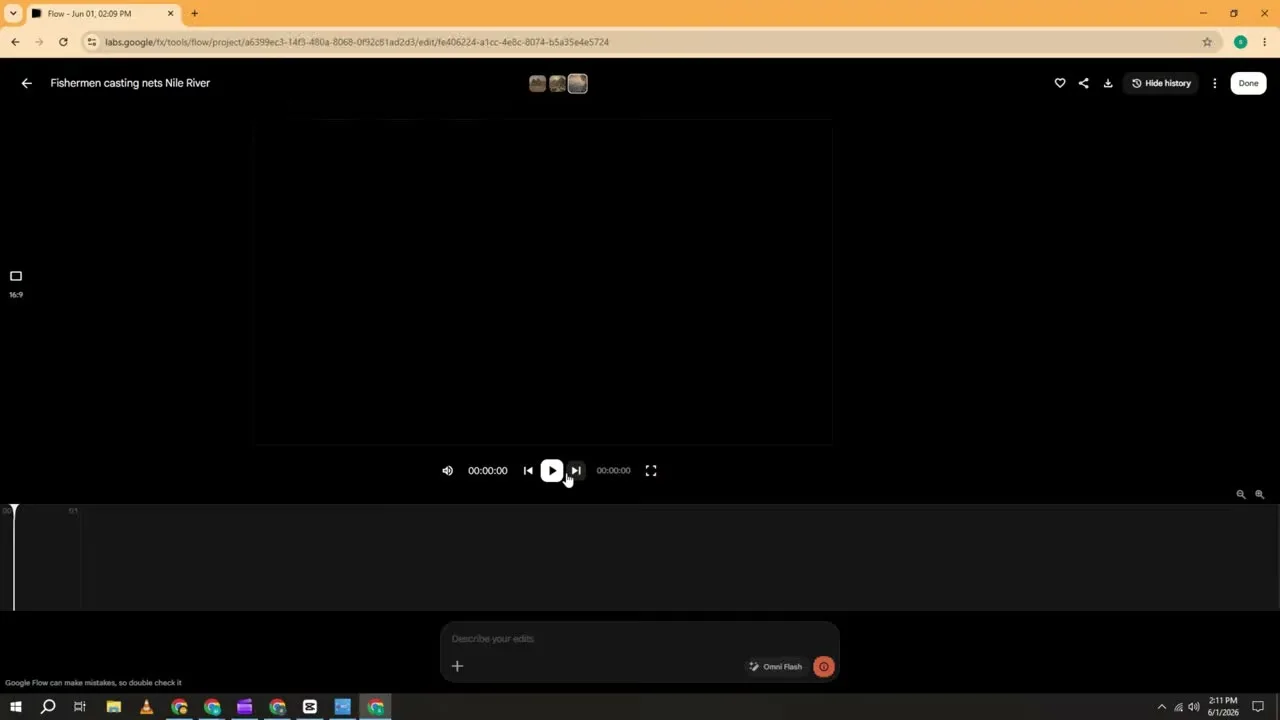
Nowhere in that chain is there a research step. Not a source list, not a fact-check pass, not even a prompt that asks the model to flag uncertainty. The script for a video about five millennia of Egyptian history is exactly as reliable as a single unstructured ChatGPT completion — which, per the research below, is not very reliable at all — and the narration tool inherits that script verbatim.
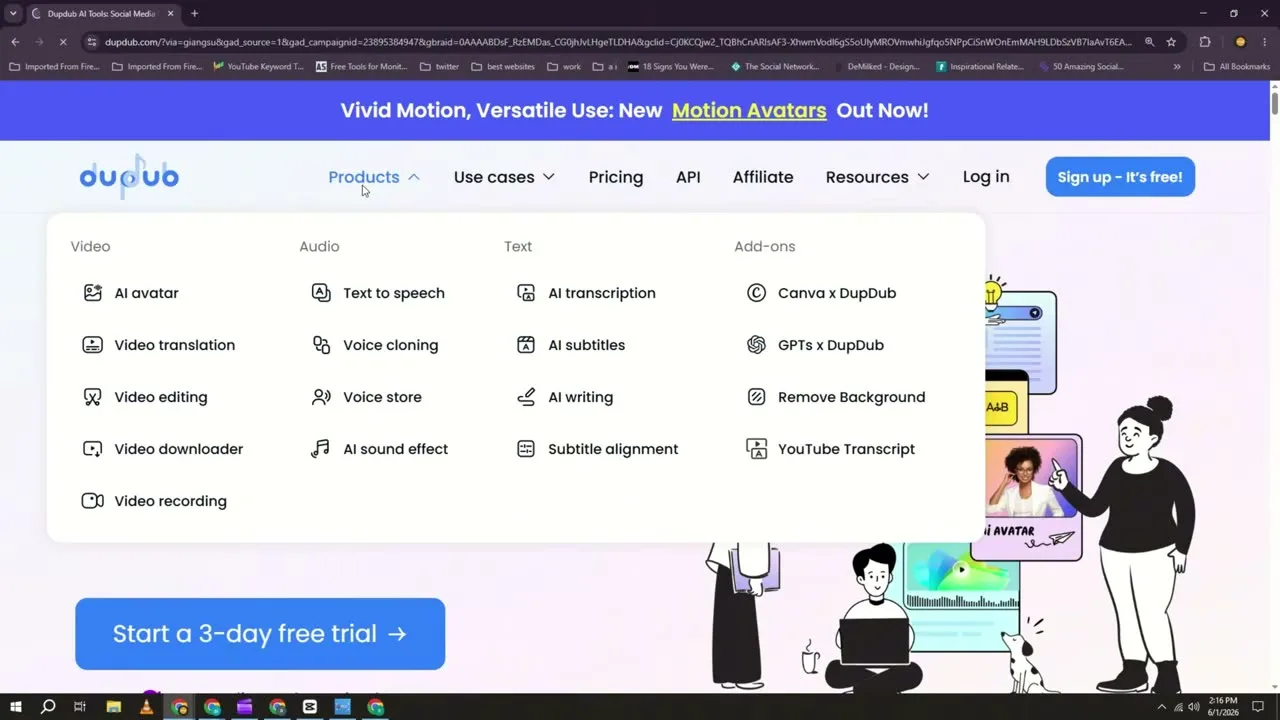
Scoring the finished workflow against the four requirements above makes the gap concrete:
The script came from one ChatGPT prompt template, chosen from ten auto-generated topic ideas. No source list, no citation step, no fact pass anywhere in the walkthrough.
Every shot is a fresh Flow AI generation — a scene literally titled "Fishermen casting nets Nile River" — with nothing marked as recreation versus record for the viewer.
A stock voice picked from a preset list in a text-to-speech tool, applied to the unverified script. Competent delivery, no relationship to the actual research.
Finished at 8 minutes "to keep the video clear" — a fraction of a real documentary upload, with no scene-tracking shown for holding continuity past that length.
None of that makes the tutorial useless — it’s an honest, popular guide to the fastest way to get a video out, and the video it produces will look reasonably polished on a thumbnail. It also isn’t alone. The same video points to three real channels already running this exact playbook at scale: Majestic Studios (now past 228,000 subscribers), Timelapse Studio (roughly 68,600), and Mike’s POV History (roughly 13,400) — proof the format finds an audience even without a sourcing step.
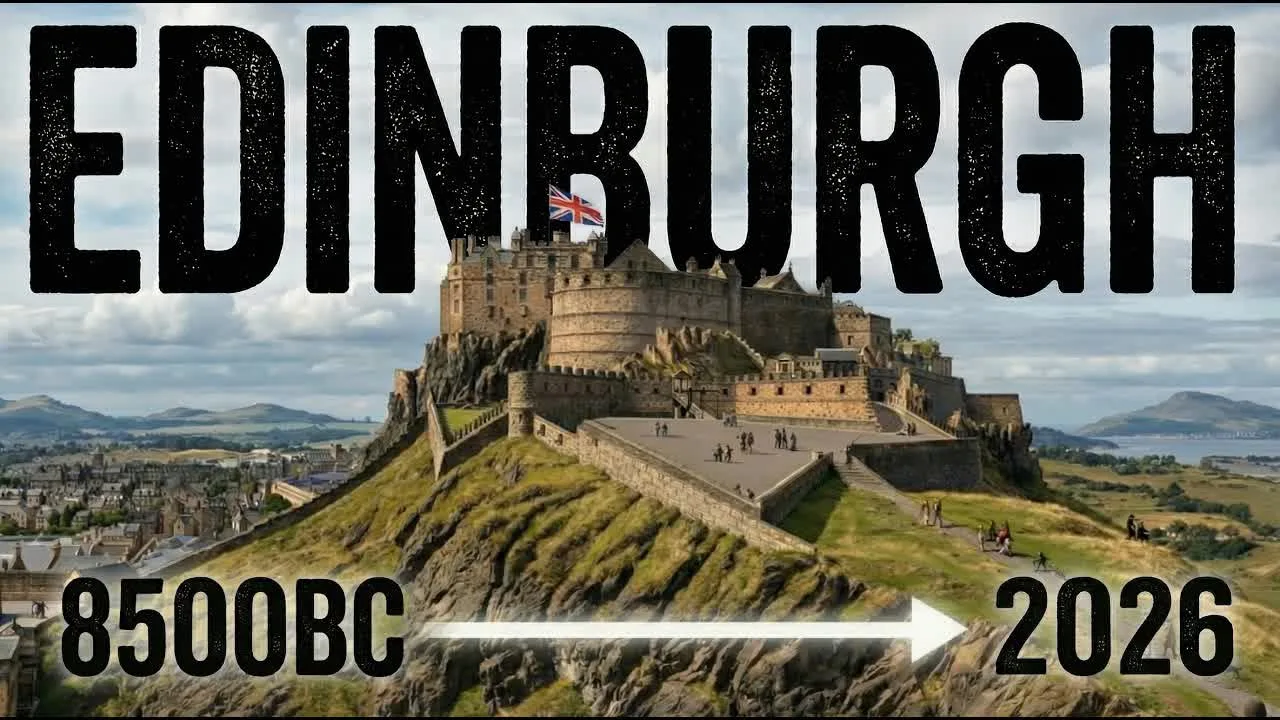
That thumbnail is the whole problem in miniature: “8500BC” reads as a fact, sits in the same typeface as the channel’s other precise-looking dates, and has no source attached anywhere a viewer can check it. It doesn’t matter whether the number is right. What matters is that nothing in the production process could tell you either way.
If you love Art, History or Philosophy then stop watching all YouTube videos “created” since feb 2025. Gen AI videos with garbled AI text, images and artificial voice have flooded YouTube & they contain many factual errors - contaminating history, destroying truth.
— @MrEwanMorrison on X
That reaction lines up with what the research on ungrounded generation actually shows. Stanford’s RegLab tested general-purpose chatbots against more than 800,000 verifiable factual questions and found hallucination rates of 58–88% — GPT-4 at 58%, GPT-3.5 at 69%, Llama 2 at 88% — on questions with a single checkable right answer. That study tested legal research specifically, but the mechanism is general: a model asked to state facts it wasn’t explicitly grounded against will confidently state wrong ones at a high rate, and nothing about “write a documentary script about ancient Egypt” grounds the model in anything at all.
Archival footage, generated visuals, and the accuracy line real events draw
Real events demand real sources — this is not optional
AI-generated “archival” footage has no provenance. It was never captured by a camera at a specific time and place — there’s no negative to examine, no metadata to verify, no chain of custody to trace. Presenting it as historical record, rather than as a clearly labeled recreation, is the line between a documentary and misinformation with a documentary’s production values.This isn’t a hypothetical risk. Historians studying deepfakes and historical footage point to two real precedents for what happens when a fabricated event gets treated as fact: the second Gulf of Tonkin incident, used to escalate American involvement in Vietnam, turned out never to have happened, and disputed medieval battles like Kosovo still shape modern political sentiment centuries later. Generative tools make producing that kind of convincing-but-invented material dramatically cheaper than it’s ever been — which raises the cost of getting the sourcing step wrong, not lowers it.
There’s also a narrower, practical version of this problem for anyone building a channel: YouTube’s own monetization policy on reused content draws a similar line. Archival footage or clips from other sources are monetizable when a creator adds real editorial value — original commentary, a storyline, analysis — and explicitly not when content is “downloaded or copied from another online source without any substantive modifications.” A documentary channel leaning on real archival material has to clear that bar on top of the accuracy bar above it.
None of this means archival footage or AI-generated visuals are off limits — most documentary-style channels use both. It means the production process has to know which is which, credit archival material honestly, and never let a generated recreation pass as a historical record. That distinction has to be a decision made at production time, not something a viewer is left to guess at from the thumbnail.
Generic AI video tools vs. a documentary production pipeline
What generic AI documentary tools skip, by the numbers
58–88%
Hallucination rate, general-purpose chatbots on verifiable questions
8 min
Full runtime of a widely-watched, single-prompt AI history documentary
228,000
Subscribers on one AI history channel built on the same unsourced workflow
Sources: Stanford RegLab · AI Playbook / Majestic Studios, verified via yt-dlp
| Generic AI video stack | Documentary production pipeline | |
|---|---|---|
| Research | One ungrounded prompt; no citations, no fact pass | Source-backed research with claims traceable to origin |
| Visuals | All generated, no archival/recreation distinction shown | Archival material credited; generated visuals kept consistent and clearly recreations |
| Narration | Preset TTS voice applied to an unreviewed script | Voice and pacing suited to serious material, timed to the actual script |
| Runtime | Capped short (8 min in this test) to keep the workflow manageable | Built for 15–30+ minutes without the process breaking down |
| Revising a claim | Re-run the whole script and every downstream clip | Fix the sourced claim; only the scenes tied to it regenerate |
| Rights and ethics | Not addressed — accounts hopped to dodge generation caps | Archival rights and AI-vs-real distinction handled as part of production |
This is the actual gap behind “best ai documentary maker” and “ai generated documentary” searches. The clip generators and TTS tools in the stack above are genuinely capable — Flow’s output quality and the narration in that tutorial both look fine on their own. The gap is that none of them were built to ask “where did this fact come from” or “is this clip a record or a recreation,” and a documentary is exactly the format where those two questions can’t be skipped.
What a purpose-built pipeline does differently
Longform Studio was built around this specific gap rather than as a general clip generator. Research runs source-backed with the sources kept alongside the script, not thrown away after one ChatGPT pass; the script is editable at the sentence level so a correction touches one claim instead of forcing a full rewrite; visual generation holds a consistent character or style reference across the whole episode rather than reinventing the look every scene; narration runs through ElevenLabs and is measured against the actual script timing instead of a preset voice reading a script nobody checked; and rendering is built for the 15–30 minute runtime a documentary actually needs, not an 8-minute demo. It costs $49/month for the Creator plan plus the real dollar cost of what gets generated — a transparent number, not an opaque credit balance.
That production-system difference is the same one covered in more general terms in the long-form AI video generator breakdown — scene volume, character consistency, and cost at 20+ minutes apply to any narrated long-form video, documentary or not. What’s specific to documentaries is everything above it: the research has to be checkable, and the visuals have to tell a viewer what’s real. For the non-AI version of that same discipline — structuring a documentary, sourcing it, and cutting it without a film crew — see how to make a documentary without a film crew. And if the question is less “how” and more “does this format actually work on YouTube,” how YouTube documentary channels are built and monetized covers the format itself, examples included.
The research step in particular is worth treating as its own decision, separate from which video tool renders the final scenes — what to look for in a script generator goes into that specifically, since a script tool that skips sourcing will produce the same unchecked-claim problem regardless of how good the visuals downstream look.
FAQ
Can AI actually make a documentary?
AI can generate the components — a script, narration, and scene visuals — but a tool that only does that skips the two things that make something a documentary rather than a video: sourced, checkable research and a clear line between archival record and generated recreation. Most 'AI documentary generator' tools on the market today handle visuals and narration well and skip research and the archival distinction entirely.
Is it legal or ethical to use AI-generated footage for real historical events?
There's no blanket rule against it, but AI-generated footage of real events has no provenance — no camera, no negative, no chain of custody — so presenting it as archival record rather than a labeled recreation crosses from dramatization into misinformation. Historians studying this point to real precedents, like the fabricated second Gulf of Tonkin incident, where a false 'historical' claim had lasting real-world consequences.
Why do AI-generated history videos get facts wrong so often?
Because most of them start from a single, ungrounded prompt to a general-purpose chatbot rather than sourced research. Stanford's RegLab found general-purpose chatbots hallucinate on 58–88% of verifiable factual questions when not grounded against real sources — which is exactly the setup a 'write me a script about X' prompt creates.
Can I monetize a documentary channel built on archival or reused footage?
Yes, according to YouTube's own monetization policy, as long as the channel adds genuine editorial value — original commentary, analysis, or a constructed narrative — rather than republishing clips with minimal changes. Content copied without substantive modification isn't eligible.
What's the difference between an AI documentary generator and a long-form AI video generator?
A long-form AI video generator solves scene volume, character consistency, and cost at 15–30+ minutes — problems any narrated long video has. An AI documentary generator has to solve those plus two more that are specific to nonfiction about real events: sourced, checkable research, and a clear distinction between archival material and generated recreation.
Sourced research, not a single hopeful prompt
A documentary lives or dies on whether its claims check out. Longform Studio keeps the research sourced, keeps visuals consistent across the whole runtime, and times ElevenLabs narration to the actual script — built for the 15–30 minute format a real documentary needs, not an 8-minute demo.
Start with Longform Studio$49/month plus real generation cost — no opaque credit balance.