
Do Faceless YouTube Channels Make Money? Real Numbers
Does a faceless YouTube channel make money? Yes — with RPM data by niche, Partner Program thresholds, and the real math behind a worked example.
A finance channel and a gaming channel can each pull 100,000 monthly views and land on completely different sides of a rent payment. One clears $2,000. The other clears $150. Neither number has anything to do with whether a face appears on screen — it comes down to what advertisers will pay to reach that specific audience.
So does a faceless YouTube channel make money? Yes, and the mechanics are identical to a channel with a host: YouTube doesn't know or care whether a human face appears on camera. What it pays for is watch time, ad load, and — most of all — who 's watching and what they're likely to buy. The honest answer isn't “yes, faceless channels make money” as a slogan. It's the RPM table, the eligibility thresholds, and the failure modes that keep most channels stuck at zero.
Key Takeaways
- Format doesn't set the pay rate — niche does. RPM swings 10x or more between a $5–$20 finance channel and a $0.50–$4 gaming channel at identical view counts.
- The Partner Program gate is 1,000 subscribers plus either 4,000 long-form watch hours in 12 months or 10 million Shorts views in 90 days — no separate, easier bar for faceless content.
- Same 96,000-view month, same production effort: $960 in a finance niche versus $144 in general entertainment — a 6.7x gap from topic choice alone.
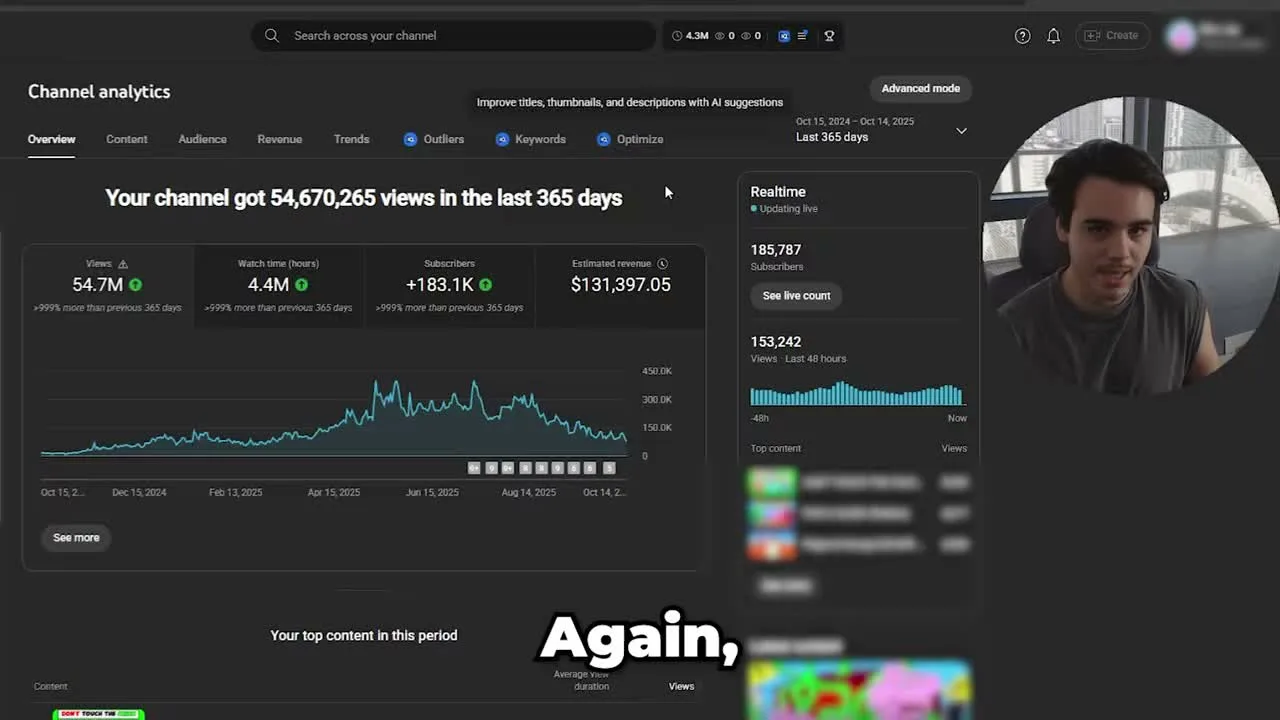
- A real low-RPM channel still pays out at scale: faceless creator Chris Barrera's Roblox channel posted $131,397.05 over 54.7M views in the trailing 365 days — roughly a $2.40 RPM.
- Most “zero-revenue” channels fail on one of three specific things — reused content, inconsistent publishing, or quitting before month 6–18 — not on the format itself.
Does a faceless YouTube channel make money the same way a normal channel does?
Mechanically, yes. YouTube's ad system attaches revenue to a video based on its content, audience, and ad format — not the format of the channel producing it. A narrated documentary about supply chains and a vlog of someone's face at a desk are evaluated by the same auction. What differs between faceless and on-camera channels is usually niche selection, not payout mechanics: faceless production makes it cheap to run explainer, finance, history, and true-crime formats that happen to sit in high-RPM categories, which is part of why the format gets associated with better earnings than it structurally deserves credit for.
The other mechanical fact worth stating plainly: eligibility rules apply the same way. There's no separate, lower bar for faceless content, and no special exemption either.
The current YouTube Partner Program thresholds
As of mid-2026, a channel qualifies for the YouTube Partner Program — the gate to AdSense revenue — by hitting one of two paths in the trailing 12 months:
| Path | Subscribers | Additional requirement |
|---|---|---|
| Long-form | 1,000 | 4,000 valid public watch hours in the last 12 months |
| Shorts | 1,000 | 10 million valid public Shorts views in the last 90 days |
Both paths also require: no active Community Guidelines strikes, 2-Step Verification enabled, residency in an eligible country, and a linked AdSense account. Watch hours accrued from Shorts viewed in the Shorts feed do not count toward the 4,000-hour long-form threshold — the two paths are tracked separately.
4,000 watch hours sounds abstract until you convert it. At a 15-minute average video length, that's roughly 16,000 individual full watches — but real audiences don't watch to completion, so in practice it's closer to 40,000–80,000 views across a channel's early catalog, depending on retention. That's the actual bar a new long-form faceless channel needs to clear before a single ad dollar arrives.
RPM by niche: the number that actually decides your income
RPM (revenue per mille — what you're paid per 1,000 views, after YouTube's cut) is the number that separates a channel that supports someone and a channel that buys them a coffee. It varies by 10x or more purely based on topic, and this is the gap most “start a faceless channel” content glosses over. If the mechanics behind the number are fuzzy, YouTube RPM explained covers how RPM relates to CPM and what actually moves it.
| Niche | Typical RPM (US) | Why |
|---|---|---|
| Personal finance / investing | $5–$20 | Banks, brokerages, and fintech advertisers bid aggressively for financial intent |
| Business & marketing | $5–$15 | High-value B2B and SaaS advertisers |
| Tech & productivity | $4–$12 | Software and hardware advertisers with real budgets |
| Education & how-to | $3–$8 | Moderate advertiser demand, broad appeal |
| Fitness & wellness | $2–$7 | Supplement and subscription advertisers, mid-tier CPC |
| Fashion & beauty | $1.50–$6 | Retail advertisers, seasonal demand |
| Gaming | $0.50–$4 | Game publishers have narrower, lower budgets |
| Entertainment & vlogs | $0.50–$3 | Mass-market advertisers pay the least per impression |
These are typical ranges compiled from creator-economics trackers, not a guarantee for any individual video — actual RPM shifts with audience country, season (Q4 is higher, January is lower), video length, and how many ad breaks a video supports. But the pattern is consistent across every source that publishes this data: finance and business content earns five to ten times more per view than entertainment or gaming content, at identical view counts. If you're choosing a niche partly for income, RPM is not a minor input — it's close to the whole equation. That's also why the niches worth building around tend to cluster in the categories with real advertiser demand behind them, not just the ones with the most search volume.
The two ends of that table have real, verifiable channels sitting on them.
How Money Works
~1.7M subscribers · high-RPM niche
Faceless, narrator-and-graphics economics and finance explainers — grown to roughly 1.7M subscribers largely on the strength of the high-RPM niche it sits in.
Best for: Proving the top of the RPM table with a real subscriber count, not a projection.
Lofi Girl
~15.8M subscribers · lowest-RPM niche
One of YouTube's biggest ambient/entertainment channels, around 15.8M subscribers on 24/7 lofi hip-hop streams — a format that racks up enormous watch time but sits in the lowest-RPM category on the table, which is why revenue leans heavily on Spotify, merch, and licensing instead.
Best for: Showing why huge watch time in the wrong category still isn't primarily an AdSense business.
The worked example: what an actual month looks like
Take a mid-sized faceless finance-explainer channel: 8 long-form videos published in a month, averaging 12,000 views each, at a $10 RPM (mid-range for the niche). Swap only the niche to general entertainment at the same output and view count, and the same $10 RPM assumption becomes $1.5.
Same production effort, same 96,000 views, a 6.7x gap in outcome — purely from topic choice. Scale either example to a channel doing 300,000–500,000 monthly views (achievable for an 18–24 month-old channel publishing consistently) and the finance channel is in $3,000–$5,000/month territory from ads alone, while the entertainment channel is still under $1,000. Neither of these numbers is a promise — they're what the published RPM ranges imply at those view levels, and real channels land above and below them constantly.
A real channel at the low-RPM end of the table shows how the math still pays out once views get large enough. Faceless creator Chris Barrera runs a Roblox content operation, and in The Faceless Roblox Channel That Made Me $131,397 (Full Breakdown) he pulls up the actual YouTube Studio analytics panel for one of his channels: 54,670,265 views and $131,397.05 in estimated revenue over the trailing 365 days — an RPM around $2.40, squarely in the gaming range from the table above. He's explicit that the videos aren't camera-recorded at all; a team produces them from trending Roblox characters and formats. Treat the number as a real, verifiable data point for the bottom of the RPM table, not a blueprint to copy — the video itself is also a case study built to drive an audience toward his own paid programs, which is worth knowing before taking any of his production advice at face value.
Chris Barrera's faceless Roblox channel — trailing 365 days
$131,397.05
Estimated revenue, trailing 365 days
54.7M
Total views over the same period
~$2.40
Effective RPM — squarely in the gaming range
Sources: The Faceless Roblox Channel That Made Me $131,397 (Full Breakdown), Chris Barrera
The exact moment he reveals that number on-screen is worth seeing directly.
Why most faceless channels make zero, not “less”
The gap between “faceless channels can be profitable” and “my faceless channel makes nothing” is almost never the format. It's one of three specific failures.
Reused content gets a channel demonetized outright, not just underpaid
YouTube's policy is explicit: channels built on “re-posting material from other websites or platforms, or other videos without adding anything of your own” can have monetization suspended or the channel terminated, full stop — see YouTube's spam, deceptive practices, and scams policy. This is the actual mechanism behind every “faceless channels are all reused clips” complaint: those channels aren't earning less, many aren't earning at all, because they never cleared the bar to begin with. A channel built on original scripts, original narration, and original visuals doesn't touch this problem.Inconsistency resets the algorithm's confidence, not just the upload count
A channel that publishes 6 videos in a burst and then goes quiet for two months doesn't retain the audience-discovery momentum it built. Every restart is closer to starting over than resuming. The channels that clear 4,000 watch hours in a reasonable timeframe are the ones publishing on a schedule they can actually sustain for a year, not the ones that publish hardest in week one.Quitting before monetization is the single largest cause of “zero”
It's the point where effort has been spent and no return has landed yet. Most channels that reach 1,000 subscribers and 4,000 watch hours got there somewhere between month 6 and month 18 of consistent publishing — and the majority of channels that start don't reach month 6. The math above only pays out to channels still publishing when the threshold clears.If the bottleneck is the production grind — research, scripting, sourcing visuals, timing narration, re-rendering after every edit — that's the specific gap Longform Studio is built to close: one workspace that takes a long-form video from source-backed research through scripting, consistent-character image generation, ElevenLabs narration, and cloud rendering, with per-scene regeneration so a single sentence fix doesn't mean re-rendering the whole video. It doesn't change your RPM or your niche. It changes whether you're still publishing in month 9, which is the variable that actually predicts whether any of this table ever applies to you. For the earlier steps — picking a niche, structuring the first uploads — how to start a faceless YouTube channel covers the setup this article assumes.
Revenue beyond AdSense
AdSense is the floor, not the ceiling, and for channels above roughly 50,000 monthly views it's often not even the majority of revenue.
Sponsorships
$500–$5,000 per integrated read
Independent of AdSense RPM — sponsors pay for audience relevance, not raw ad economics.
Best for: Mid-sized finance, tech, and education channels with a defined audience.
Affiliate links
Software, brokerages, courses, gear
Converts well because the viewer clicked in already looking to purchase.
Best for: Finance, tech, and how-to niches where the audience is already in a research-and-buy mindset.
Own products
Templates, courses, communities
The highest-margin tier, and the least exposed to a single algorithm or policy shift.
Best for: Channels ready to monetize the audience directly, without depending on ad rates at all.
A channel that treats AdSense as the entire business is leaving the higher-margin revenue on the table — and it's also the most exposed to a single algorithm or policy shift.
If you're still evaluating whether the format itself is legitimate before committing to a niche, is YouTube automation legit is the more skeptical companion piece to this one.
FAQ
Does a faceless YouTube channel make less money than a channel with a face?
No — the format itself doesn't set the pay rate; the niche and audience do. A faceless finance channel typically out-earns an on-camera gaming channel by 5–10x per view, because RPM tracks advertiser demand for the topic, not whether a presenter appears on screen.
How much do faceless YouTube channels actually earn per month?
It depends almost entirely on niche and view count: an 8-video, 96,000-view month in personal finance (around $10 RPM) lands near $960 in AdSense revenue, while the same output in general entertainment (around $1.50 RPM) lands near $144. Sponsorships and affiliates can add more on top once a channel has a defined audience.
How many views do I need before YouTube pays me anything?
None directly — payment starts only after Partner Program approval, which requires 1,000 subscribers plus either 4,000 long-form watch hours in 12 months or 10 million Shorts views in 90 days. Views before that point build toward eligibility but generate no ad revenue.
Can a faceless channel using stock footage or reused clips get monetized?
Not if it's simply re-posted material without original contribution — YouTube's policy allows monetization suspension or channel termination for scraped or repetitious content. A faceless channel built on original scripts, original narration, and original or licensed visuals with real editorial work doesn't trigger this rule; one built on lightly-edited reposts does.
What faceless niche has the best RPM in 2026?
Personal finance and business/investing content consistently posts the highest published RPMs, typically $5–$20, because financial-services advertisers pay premium rates for that audience. Gaming and general entertainment sit at the other end, typically $0.50–$4, regardless of view count.
The niche decides your RPM. Consistency decides if you ever collect it.
Nine months of publishing is what separates the RPM table from an actual paycheck. Longform Studio handles the research, scripting, imagery, and narration so the production grind isn't the reason you stop at month 6.
Try Longform StudioNo markup on provider usage.