
How Long Should a YouTube Video Be? Data by Goal
How long a YouTube video should be for search, retention, and revenue — the 8-minute mid-roll rule and ideal lengths by content type.
A 4-minute video with 85% retention will out-earn a 20-minute video that loses most of its audience by the halfway mark. But a 3-minute video can’t carry a single mid-roll ad, no matter how well it retains. So how long should a YouTube video be? The honest answer is that it depends entirely on what the video is for — a search-driven tutorial, a vlog, a documentary, and a reaction video don’t share an ideal length, and the data behind each one is public. Here’s what it actually says, by goal, not by guess.
Quick answer
Search & tutorial: 6–12 min. Entertainment & commentary: 10–20 min. Vlogs & lifestyle: 10–15 min (20–30 for travel). Documentary & deep dive: 20–45+ min. Podcast & interview: 45–90+ min. The one number that cuts across all of them: 8 minutes, the minimum runtime YouTube requires before a monetized video can carry mid-roll ads.
Key Takeaways
- There’s no single ideal length — search tutorials perform best around 6–12 minutes, documentaries and deep dives at 20–45+, and the data behind each is different.
- 8 minutes is the minimum runtime for mid-roll ads, not a target to pad toward — retention data punishes filler added just to clear the floor.
- An analysis of 4.5 million videos across 18,080 channels found longer formats out-engage shorter ones in most niches, but not without limit — business and finance content peaks around 1–2 hours, then drops.
- A realistic retention target for a 6–9 minute video is around 30% average percentage viewed; the platform-wide average sits in the low-to-mid 20s.
- Retention doesn’t fail all at once — it drops in three predictable zones: the opening cliff, the setup sag, and the mid-video sag.
Video length, by the numbers
8 min
Minimum length to unlock mid-roll ads
~30%
Realistic retention target for a 6–9 min video
4.5M
Videos analyzed across 18,080 channels for length data
20–30 min
Where gaming, DIY, and documentary engagement peaks
Sources: YouTube Help — about mid-roll ads · vidIQ — audience retention benchmarks · AIR Media Tech — video length by niche
How Long Should a YouTube Video Be, by Goal?
Every “ideal length” number floating around the internet is really an average of very different content types mashed together. Split it by what the video is actually trying to do, and the ranges stop being vague:
| Goal | Ideal length | Why | Real example |
|---|---|---|---|
| Search & tutorial | 6–12 min | Viewer has a specific question; length should match the real answer, not a target | MKBHD's 9-minute headphone review |
| Entertainment & commentary | 10–20 min | Engagement climbs with length across most of a 10-niche, 4.5M-video study, up to a point | — |
| Vlogs & lifestyle | 10–15 min (20–30 for travel) | Simple hook → story → payoff arc; travel vlogs specifically reward the longer end | Yes Theory, ~24–45 min episodes |
| Documentary & deep dive | 20–45+ min | The format exists to go deep — cutting it short defeats the point | Wendover Productions, ~20–25 min episodes |
| Podcast & interview | 45–90+ min | Session-length content; viewers opt into the whole conversation, not a highlight | — |
The pattern across every row: length follows intent. Someone who typed a specific question into search wants the answer in minutes, not chapters. Someone who clicked a 73-minute deep dive already decided they have the time. Padding either one to hit a different number is the mistake, not the length itself.
The 8-Minute Mid-Roll Floor (Not the Target)
The one hard number in this whole topic comes straight from YouTube’s own help documentation: “On monetized videos that are 8 minutes or longer, you can turn on ads during the middle of the video”. Below 8 minutes, a video can still run pre-roll and display ads — it just can’t carry mid-rolls, which is where a meaningful share of long-form ad revenue actually comes from.
That single number is also the most misapplied one in YouTube strategy. Creators round a 6-minute video up to 8-and-a-half minutes with a recap nobody asked for, and the retention curve shows exactly where the padding starts. The floor is worth clearing when the content genuinely earns it — it is not a target to write toward. For the full breakdown of the 8-minute threshold, the 3-minute Shorts cutoff, and how YouTube defines long-form in the first place, see what counts as a long-form video on YouTube.
Retention vs. Length: How Long Should a YouTube Video Really Run?
vidIQ’s retention guidance puts a number on what “good” looks like: a realistic target for a 6–9 minute educational video is roughly 30% average percentage viewed. Third-party studies of thousands of videos put the platform-wide average closer to the low-to-mid 20s, with only a small share of videos clearing 50%. vidIQ’s own 2.39M-subscriber channel averages 30.3% across 16.5 million long-form views — a real benchmark, not a marketing number.
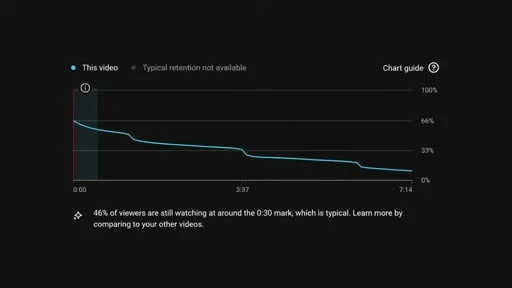
The math that actually matters
Shorter videos retain a higher percentage and longer videos retain a lower one, so there’s no single target across lengths. A 30-minute video holding 35% can deliver far more total watch time than a 4-minute video holding 80% — which is exactly why “longer” and “better retention” are two different goals, not one. Chase whichever one your content and your ad revenue actually depend on.The practical version of this, per vidIQ’s own guidance: don’t chase a fixed number by length. Match the length to the topic instead of padding for the algorithm. If you can cover it well in five minutes, stop at five minutes — padding creates dips, and dips are what the algorithm actually reads.
Where Longer Videos Actually Lose People
Retention doesn’t fail as one smooth downward line — it fails in specific, repeatable places. vidIQ’s own editing breakdown names three of them, and once you know where to look, they show up on almost every retention graph:
The Cold Open Cliff
0:00–0:30
- Viewers decide before a word is even spoken
- A static talking-head open reads as dead air
- A slow push-in plus a held beat outperforms a rushed hook
Best for: Fixing it with a visual question on screen, not your face mid-sentence.
The Setup Sag
After the hook, before the payoff
- Creators frontload context and caveats before earning trust
- Trimming too aggressively cuts the substance people came for
- Starting mid-action and explaining as you go keeps momentum
Best for: Leading with what they came for, then explaining the background after.
The Midroll Sag
The middle third of the video
- The opening hook buys roughly 30–60 seconds of goodwill, then attention drifts
- A longer runtime simply gives this zone more room to open up
- Rotating footage types (A-roll, B-roll, motion graphics) resets momentum
Best for: Treating the middle like a second cold open, not the boring part.
The reason this matters for length specifically: every extra minute you add to a video is another lap through the mid-roll sag. A 25-minute documentary and an 8-minute tutorial both have a cold open and a setup — but the documentary has to survive that middle zone four or five times over. Length isn’t free. It has to be earned one zone at a time.
Does Longer Always Win? What 4.5 Million Videos Show
AIR Media Tech analyzed 4,538,463 videos across 18,080 English-language channels, published between 2025 and March 2026, to find the length that drives engagement in each of 10 niches. The headline finding: longer videos out-engage shorter ones in almost every niche — but the shape of that curve isn’t the same everywhere, and it isn’t infinite.
Engagement keeps climbing all the way to the 1–2 hour bucket — going below 10 minutes costs meaningful engagement at every tier in this niche.
The most striking figure in AIR’s entire study — then it drops. Longer isn’t a straight line even in the niche where it pays the most.
Both shapes show up across the other eight niches AIR tracked. Gaming and DIY channels peak at 20–30 minutes, with the longest formats holding the strongest engagement at every size tier — gaming specifically because it’s one of the most TV-dominant niches on YouTube, and TV viewers don’t need re-hooking every 90 seconds the way a mobile viewer does. Tech review channels favor 10–20 minutes over 5–10 at every tier where data exists — a business creator publishing 7-minute explainers is getting roughly 63% of the engagement of one producing 12-minute videos on the same topics. Fitness and beauty peak in the 10–20 minute band and hold there strongly. The consistent loser across all ten niches: the 5–10 minute range, which is where most creators default and where the least engagement concentrates.
If you’re building toward a 20-plus-minute documentary-style video and don’t yet know whether the topic actually earns that runtime, that’s exactly the uncertainty Longform Studio’s script stage is built to remove — it times narration sentence by sentence against measured ElevenLabs voice output before anything renders, so the runtime on screen is measured, not guessed, while the script is still editable enough to cut a section that isn’t earning its minutes.
Correlation, not causation
AIR’s researchers are explicit about this: the numbers show what high-engagement channels do, not that length alone caused the result. Execution quality, topic selection, and packaging all move the needle too. What the data rules out is the idea that length is a minor variable — the pattern across 4.5 million videos is too consistent to dismiss.Match the Runtime to the Content, Not the Algorithm
This is where the data and YouTube’s own creator guidance land in the same place. YouTube’s Creators channel has made the point directly on camera — runtime should match the content, not a target number — and the full breakdown of that guidance covers the quote in detail. The short version is the same conclusion every dataset in this article points to: padding for length and cutting everything short to protect a retention percentage are both the wrong default.
“a 3-minute video viewers love will now outrank a 20-minute video they tolerate. this single change killed the ‘make it longer’ strategy that 90% of faceless creators have been running since 2023.”
— Haris, @fyreinteractive on X
That’s one creator’s read on X on where the algorithm is heading, not an official policy statement — but the direction matches everything else here. If you’re still deciding whether long-form is worth the extra production time at all, before you get to the question of exactly how long, our long-form vs. short-form comparison covers that trade-off with real RPM figures. And once you’ve settled on a length, pacing a script to hit a target runtime is the next practical step — length is a script-writing decision as much as an editing one.

Length answers what to make. Upload cadence answers a different question — how often to show up while you’re making it — and that trade-off is its own set of data; see how often you should actually be posting. For deep-dive, documentary-style formats specifically, pairing the runtime with a script built to stay relevant matters too — see how to make a documentary without a film crew and, for the format built to keep earning views long after publish, which content formats hold up for years.
FAQ
Is there one ideal YouTube video length?
No — the data splits by goal. Search-driven tutorials tend to peak around 6–12 minutes, entertainment and vlogs do well anywhere from 10 to 30 minutes, and documentary-style deep dives often run 20–45 minutes or longer. The one number that applies across all of them is 8 minutes, the minimum runtime YouTube requires before a monetized video can carry mid-roll ads.
Do longer YouTube videos get more views?
Often, but not automatically. An analysis of 4.5 million videos across 18,080 channels found longer formats out-engage shorter ones in most niches — gaming, DIY, and documentary-style content all peak at 20 minutes or more. But it isn't universal: business and finance channels saw engagement spike around the 1–2 hour mark and then drop past 2 hours, and every niche in the study showed diminishing returns once a video ran past what the topic actually needed.
How long should a YouTube tutorial or how-to video be?
Most data points to 6–12 minutes for a straightforward how-to, extending to 15–20 minutes for anything with multiple steps or troubleshooting. Tech review and DIY channels consistently out-engaged with 10–20 minute uploads over anything under 10 minutes — viewers who search for a specific answer will stay for the whole explanation, but only as long as it keeps earning that time.
Should I stretch a video to hit 8 minutes for mid-roll ads?
No. Padding to clear the mid-roll floor is one of the most common ways creators sabotage their own retention curve — a 6-minute video that says everything it needs to will often out-earn a 9-minute version of the same video with two minutes of filler, because distribution runs on retention and satisfaction signals, not runtime alone. Clear 8 minutes only when the content genuinely needs that long to say what it's saying.
Does the ideal video length change as a channel grows?
Yes. Engagement rates for every length bucket, in every niche studied, decline as a channel scales from the 100K–1M monthly view tier up to 50M–100M — a pattern researchers attribute to smaller, more loyal audiences engaging more per video than mass audiences. The length that performs best for a 200,000-subscriber channel isn't necessarily the length that performs best for a 5-million-subscriber one, so check your own retention curves rather than copying a number from a bigger channel.
Know your runtime before you render
Longform Studio times your narration sentence by sentence against measured ElevenLabs voice output before a single frame renders, so you see the actual length of your video — not a guess — while the script is still editable enough to fix it.
Try Longform Studio$49/mo plus transparent, per-dollar production costs. No markup on provider usage.