
Evergreen YouTube Content: Videos That Earn for Years
What makes YouTube content evergreen, which formats keep earning for years, and how to build a channel on compounding views.
Key Takeaways
- A vidIQ tutorial on YouTube hashtags kept pulling 500–600 views a day a full year after it was published — over 15,000 views a month, untouched.
- Evergreen content is defined by three things at once: a search-driven query people keep typing, an undated framing that doesn’t expire, and a durable topic nobody stops needing.
- In a 24-month model built from creator-reported ranges, an evergreen video starts 6x behind a trending video’s first-month total — then finishes with roughly 7x more cumulative views.
- Tutorials, explainers, documentaries, and rankings compound. Reaction videos and breaking news don’t — they’re built to be replaced.
- Editing a title or thumbnail after publishing doesn’t reset a video’s view count — which means a dated title is a fixable mistake, not a permanent one.
A tutorial on YouTube hashtags went up in July 2018. A year later it was still pulling 500 to 600 views a day — more than 15,000 a month — on a video nobody had touched since the day it was published. The creator who made it, vidIQ, put the actual YouTube Studio numbers on screen rather than describing them from memory: a quarter of a million views in year one, a 10% click-through rate, and the #1 search ranking for “YouTube hashtags” that made all of it possible.
That’s the entire case for evergreen YouTube content in one example: a video that keeps earning long after its upload date stops mattering, because it was built to answer a question people are still typing into the search bar. Most videos don’t do this — they spike, they fade, they’re gone within a month. This article is about the difference: what makes a video evergreen, what that’s worth over two years compared to a trending hit, which formats hold up, and how to fix a title that’s already dated before it costs you the ranking.
What a real evergreen video does after the first year
500–600
Views per day, one year after publish
10%
Click-through rate, still above channel average
#1
Search rank for its target query, held for a year
8,000 hrs
New YPP watch-hour bar for applicants from Feb 2027
Sources: vidIQ — How to Get More Views On YouTube... FOREVER! · YouTube — Partner Program updates for 2027
What makes a video evergreen
“Evergreen” gets used loosely, but it only means one thing precisely: a video that keeps getting discovered and watched at a roughly steady rate, months or years after it was uploaded, without further promotion. Three conditions have to hold together for that to happen.
It answers a search-driven query, not a moment. Evergreen content lives or dies on YouTube’s own search ranking system, which weighs relevance (how well your title, tags, and video match the query), engagement (watch time for that specific search), and channel authority. None of those factors care when a video was made — they care whether it’s still the best answer to a question someone is asking today. vidIQ’s hashtags video held #1 for a year for exactly that reason: it was first to cover a real search term, and nothing better replaced it.
It’s framed without a date. A video titled around a year, a version number, or a single event puts its own expiration date in the metadata. A viewer—and the algorithm matching queries to results—can tell instantly that a 2023 title is stale in 2026, even if the content inside hasn’t changed. Undated framing isn’t about hiding when something was made; it’s about not building an artificial shelf life into the title itself.
It covers a topic that doesn’t stop being needed. This is the one creators underrate. A phone review has a shelf life measured in one product cycle. A video on how a specific financial concept works has a shelf life measured in decades, because the underlying need — people trying to understand it — never goes away. Durability isn’t about the niche; it’s about whether the specific question you’re answering gets asked again next month, and the month after that.
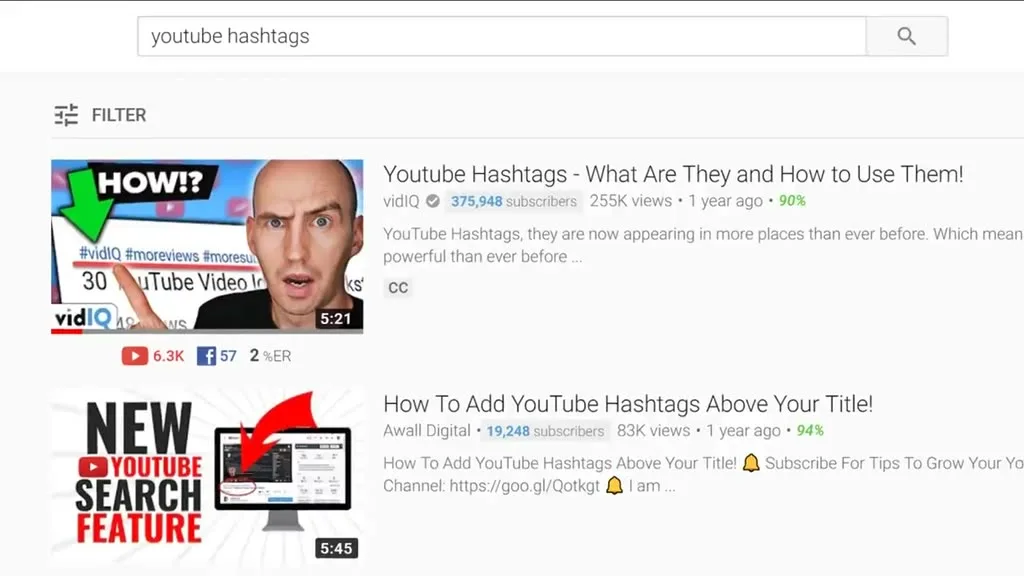
vidIQ’s Rob walks through a second, smaller example in the same video that shows the mechanism working in real time: a tutorial on how to delete a YouTube video, ranking #2 behind a channel with a million views, built deliberately short — under three minutes, with the answer delivered in the first 30 seconds — because evergreen, solution-based searches reward getting to the point, not padding watch time. The screenshot below is from that same search result, showing the hashtags video still sitting at the top a year later.
Why this matters more starting February 2027
YouTube’s current Partner Program bar is 1,000 subscribers plus 4,000 watch hours in a rolling year, or 10 million Shorts views in 90 days. On August 10, 2026, YouTube announced that new applicants from February 1, 2027 will need 8,000 watch hours or 20 million Shorts views instead — double the current watch-hour requirement. A back catalog of videos that keep accumulating watch time on their own is the only realistic way to clear a bar that high without uploading constantly.Evergreen vs. trending: the 24-month math
Here’s the actual tradeoff, worked out in numbers instead of vibes. Picture two videos published on the same day, on the same channel: one rides a news cycle or trend, one answers a durable, search-driven query. The model below isn’t a screenshot of a real dashboard — it’s built from the ranges creators actually report. vidIQ’s hashtags video sustained 500–600 views a day a year in; a separate creator running an evergreen media business reported the same 500–1,000-plus-views-per-day range on videos over a year old on X. A trending video’s shape is equally well documented: a sharp spike in the first days, then a fast decline toward a trickle once the news cycle or trend moves on.
The trending video wins the first month by a wide margin — nearly 6.5 times the evergreen video’s total. It’s already lost the lead by month four. By month 24, the evergreen video has earned roughly 7x more cumulative views than the trending one, and it’s still climbing at the same rate it was in month twelve. The trending video, by contrast, is essentially finished after week two — everything past that is rounding error.
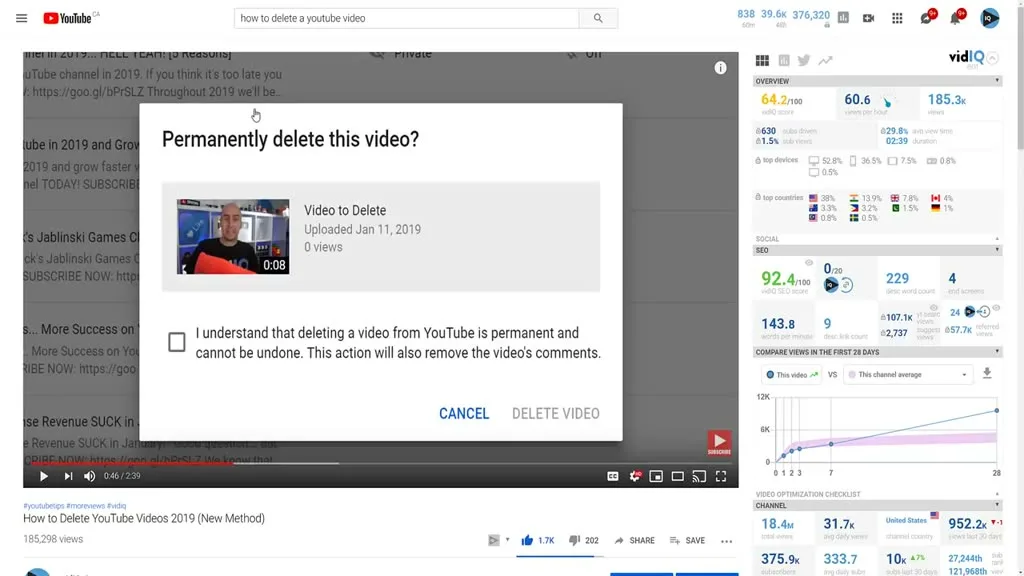
This is exactly the shape vidIQ’s own analytics show for the “how to delete a YouTube video” example: a real 28-day comparison chart where the video (blue line) starts below the channel’s average performance (pink band), then crosses above it as search traffic compounds through the month.
That slow start is the actual cost of evergreen content, and it’s worth naming plainly: the same patience that makes long-form video pay better than Shorts applies here too. A trending video feels productive in week one. An evergreen video feels like it did nothing for a month. The math above is the reason to keep making it anyway.
Formats that age best
Not every format has the same shelf life, and the difference isn’t subtle. Formats built around a fixed, answerable question compound. Formats built around a single moment don’t — they’re designed to be replaced by the next moment.
| Format | Why it compounds (or doesn't) | Needs refreshing? |
|---|---|---|
| Tutorials / how-to | Answers a task-based query people search indefinitely | Rarely — only if the tool or process itself changes |
| Explainers / concept breakdowns | Teaches a concept, not a headline — the concept doesn't expire | Almost never |
| Documentaries | Durable narrative on a settled subject with no moving news cycle | Never |
| Rankings / “best of” lists | Re-searched every time someone is deciding what to buy or try | Every 12–24 months to stay accurate |
| Reaction / trend-jacking videos | Rides one moment's attention, then the moment passes | N/A — replace with the next one |
| Breaking news / current events | Time-stamped by definition; the value is being early, not lasting | N/A |
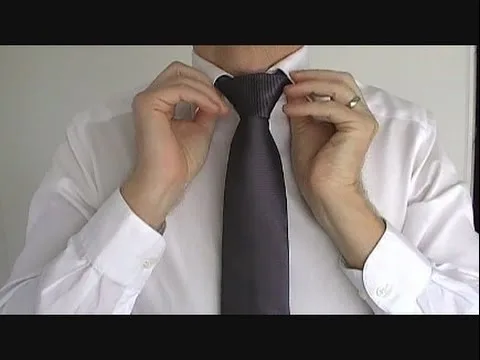
The gold-standard example — the one vidIQ uses in the same video — is a task nobody stops needing: how to tie a tie. It’s the kind of query that isn’t tied to a product cycle, a news event, or a trend, so a single well-made video can rank for a decade. One real example: a tutorial from the channel defragmenteur, uploaded in July 2015 on a channel with roughly 209,000 subscribers, has pulled in over 91 million views — almost entirely through search, almost entirely after the first few months.
This isn’t unique to YouTube search, either. Ahrefs’ research on Google web search found that the average #1-ranking page is five years old, and 72.9% of pages in the top 10 are more than three years old. Search engines, YouTube’s included, structurally reward content that has survived long enough to prove it’s still the right answer — which is one more reason a rankings video needs a refresh but a tutorial usually doesn’t: the ranking changes, the underlying task doesn’t.
If you’re still deciding what to make rather than how to make it last, our list of evergreen video ideas across niches is a better starting point than a trending-topics tool.
Retrofitting datedness out of a video
Most creators don’t plan a video into datedness — they back into it, one small habit at a time: a year in the title because it felt current, a thumbnail overlay that says “NEW,” an intro line referencing this week’s news. None of that is fatal on its own, and none of it requires a reshoot to fix.
Dated: puts an expiration date in the metadata
“Best Budget Laptops of 2024” — the year alone tells both the viewer and the search algorithm this answer is stale the moment 2025 starts, regardless of whether the actual recommendations are still good.Undated: same video, a title that doesn't expire
“Best Budget Laptops (Updated Picks)” — the comparison still gets refreshed periodically, but the title itself never needs replacing, and it keeps matching the query long after the specific year would have aged out.Dated: tied to a single news cycle
“YouTube Algorithm Changes 2026 Explained” — built around one announcement, useful for a few weeks, then competing against every newer video on the same news.Undated: tied to a mechanism instead of an event
“How the YouTube Algorithm Actually Works” — the underlying mechanics change slowly enough that this framing survives multiple news cycles instead of losing to the next one.The fix that actually matters is the one most creators don’t realize is available: editing a title or thumbnail after publishing does not reset a video’s view count, watch time, or ranking history. A dated title from two years ago can be swapped for an undated one today, on a video that’s already accumulated authority, without losing any of the signal that got it ranked in the first place. The only thing to watch is your own click-through rate for a week or two after the change, since a new thumbnail resets expectations even though it doesn’t reset the counter.
This is also where the production side of the compounding-asset argument gets practical. Fixing a dated hook or an outdated thumbnail scene shouldn’t mean re-recording a 20-minute video. In Longform Studio, the storyboard and narration are built at the scene and sentence level specifically so a single hook, title card, or visual can be regenerated on its own — the research and the rest of the script stay untouched. That’s the same logic as the retrofit above, just built into the tool instead of left as a manual workaround.
FAQ
What does "evergreen" mean for a YouTube video?
A video that keeps getting found and watched at a roughly steady rate months or years after publishing, without further promotion — because it answers a search-driven query, uses undated framing, and covers a topic people keep needing. It's the opposite of a trending video, which spikes fast on a single news cycle and then fades.
How long does it take an evergreen YouTube video to start getting real traffic?
Based on documented cases, expect a slow first month — vidIQ's own 28-day comparison shows a new evergreen video underperforming its channel average early on, then overtaking it by day 28 as search rankings settle. Full compounding typically takes a few months, not days, which is why evergreen videos feel unproductive at first even when they end up outperforming trending content within a year.
Can a trending video ever become evergreen?
Rarely, and only if the underlying topic itself is durable rather than the moment that made it trend. A reaction to a single event stays tied to that event; a well-timed explainer of a lasting concept, published during a trend spike, can keep earning through search long after the spike fades — but that's the topic being evergreen, not the trend.
Does an evergreen back catalog help meet YouTube's new watch-hour requirements?
Yes, directly. YouTube's current Partner Program threshold is 1,000 subscribers plus 4,000 watch hours in a rolling year (or 10 million Shorts views in 90 days). Starting February 1, 2027, new applicants need 8,000 watch hours or 20 million Shorts views instead. A catalog of videos that keep accumulating watch time on their own, without new uploads, is the most realistic way to clear a rolling-year threshold that high.
How do I fix a YouTube title that's already dated?
Edit it. Changing a video's title, description, or thumbnail after publishing does not reset its view count, watch time, or ranking history on YouTube — only replacing the video file itself does that. Swap a year-stamped title for an undated one, expect a short adjustment period as the new thumbnail resets click-through expectations, and the video keeps the authority it already earned.
Make videos that are still earning in 2028
This article walked through what makes a video evergreen, what that's worth over 24 months against a trending hit, and how to retrofit datedness out of a title without a reshoot. Longform Studio is built around the same throughline: research a durable topic, script and storyboard it at the sentence level, and regenerate a single scene or hook later instead of starting over.
Start with Longform StudioResearch, script, visuals, and narration built for videos meant to still earn in year three.